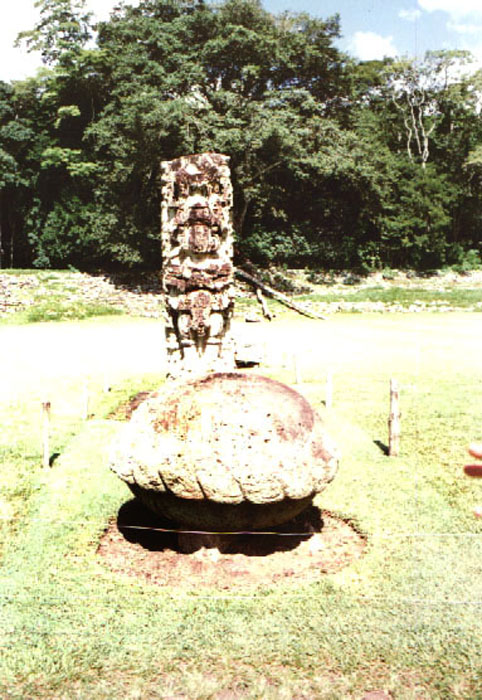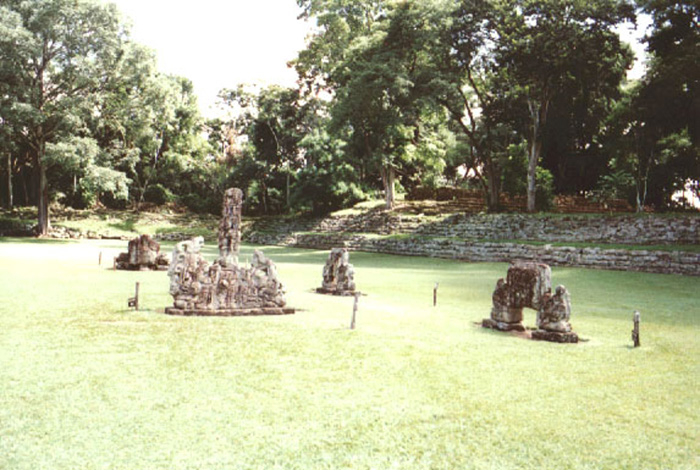
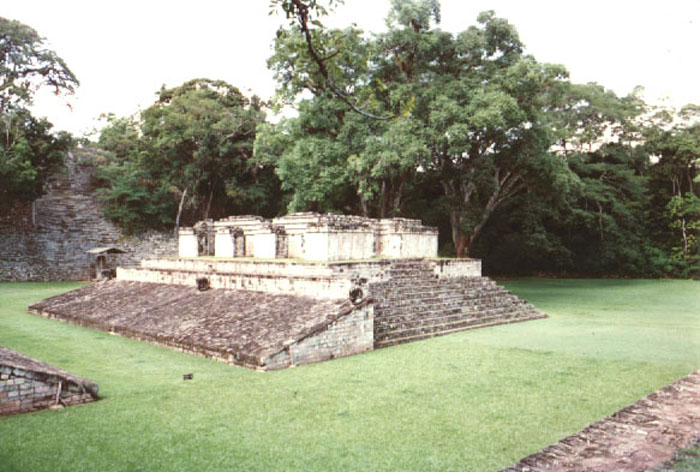


Trip to Copan (Honduras) 1996
Mayan History
Maya(mä´ye), related tribes of CENTRAL AMERICA ( MIDDLE AMERICA, INDIGENOUS
PEOPLES ) occupying the YUCATÁN and E Chiapas in Mexico, much of Guatemala and
Belize, and W Honduras, and speaking Mayan languages ( NATIVE AMERICAN
LANGUAGES). They may derive from the OLMEC, or they may have originated c.1000
B.C. among nomadic tribes in N central Petén, Guatemala, where there are
evidences of a once-flourishing agricultural people. Among indigenous American
cultures the Maya emerge as undisputed masters of abstract knowledge, with a
system of hieroglyphic writing that they used to record political and dynastic
history. Their system of mathematics was an achievement not equaled for
centuries in Europe. The 365-day Mayan year was so divided as to be more
accurate than that of the Gregorian CALENDAR. Sculpture, used in architecture,
reached a beauty and dignity unequaled in aboriginal America. Most of the
population, estimated at 14 million in the 8th cent., lived in suburban
agricultural communities. Mayan history is divided into three periods. From
early in the Pre-Classic period (1500 B.C.?-A.D. 300), corn was cultivated. Late
in that period the calendar, chronology, and hieroglyphic writing developed. In
the Early Classic (300-600), Mayan culture spread throughout the area. The
greatest Mayan accomplishments in art and science occurred in the Late Classic
(600-900) at such centers as Copán, Honduras; Palenque, in Chiapas; and UXMAL,
in the Yucatán, all abandoned in the following century. At the beginning of the
Post-Classic period (900-1697) an invasion by Kulkulcán (see QUETZALCOATL), who
conquered CHICHÉN ITZÁ, brought TOLTEC elements into Mayan culture. The Toltec
took Chichén Itzá, but were absorbed c.1200 by the Maya. In 1283 Mayapán became
the civil capital. The century preceding the Spanish conquest (1546) was
dominated by civil wars and a series of calamities. Today some 4 million Maya
retain many elements of their culture combined with that of the CONQUISTADORS.
Numerous Mayan-derived dialects are spoken, and agriculture and religious
practices owe much to Mayan tradition. A 1994 uprising in Chiapas, Mexico, drew
most of its strength from the support of Mayan peasants. The Concise
Columbia Encyclopedia is licensed from
Columbia University Press. Copyright © 1995 by Columbia University Press. All
rights reserved.